Wednesday, February 26, 2014

Houwling's Tomatoes

Tour of Houwling's Tomatoes
Mastery Under Glass
 
125 acres under greenhouse glass and the California sun produces delicious varieties of tomatoes in an array of colors, shapes and sizes 52 weeks a year.
 
View of the Heirloom Tomato Glass Greenhouse
 
Tomato vines grown hydroponically
 
Heirloom Tomatoes waiting to be packed and shipped
 
Don't I look cute in my clean suit? 
I was lucky enough to have some leaves picked from the vines.
 
 
Thanks Kyle for the Grand Tour!
 
 
While deciding what to paint for my next assignment and searching my garden and local markets, I am always drawn to Heirloom Tomatoes.  Their various shapes and colors have always intrigued me.  I purchased a few fun looking shapes, color and sizes, for quite a lot of money I might add, brought them home and started in on my sketchbook.    I like to make my sketches into greeting cards, so my first attempt at a Heirloom Tomato was for my Valentine's Greeting Card
 
Now that I've got some good pictures of the stems and leaves of these tomatoes, I can continue on with my assignment. 
 
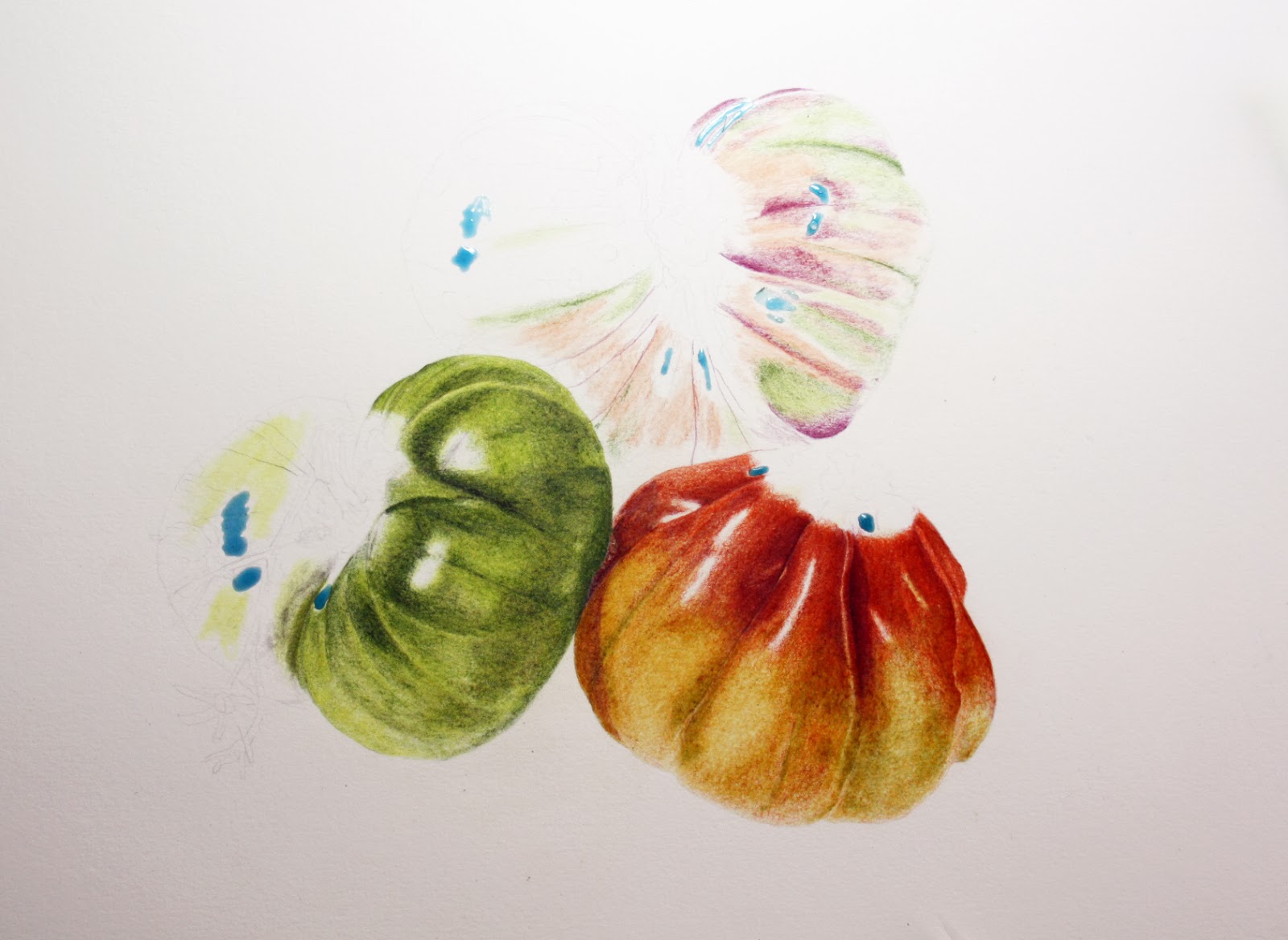
Here is a sneak peak of my assignment:
 
 
Lots of pretty colors happening!
Still have a lot of coloring to do, but now I have a lot of pictures,
stems and leaves to use for reference. 
 
 
Check Back to see my final artwork!


Monday, February 3, 2014

SBA Assignment #7 Composition 2 - Fruit Study

Carissa macrocarpa  (Natal Plum)
A shrub native to South Africa, where it is commonly called the Large Num-Num. In Zulu, as well as in the Bantu tribes of Uganda, it is called amatungulu. In Afrikaans the fruit is called Noem-NoemC. macrocarpa deals well with salt-laden winds, making it a good choice for coastal areas. It is commonly found in the coastal bush of the Eastern Cape and Natal.  It produces shiny, deep green leaves and snowy white flowers whose perfumed scent intensifies at night. Like other Carissa species, C. macrocarpa is a spiny, evergreen shrub containing latex. They bloom for months at a time. The ornamental plump, round, crimson fruit appears in summer and fall (autumn) at the same time as the blooms. In moderate, coastal areas the fruits appear through the year. The fruit can be eaten out of hand or made into pies, jams, jellies, and sauces.  Some claim that other than the fruit, the plant is poisonous.  However this claim is a myth, possibly based on similarities to other plants with milky sap.  The California Poison Control System rates the plant as mildly toxic.


When starting an assignment, I always try to pick my material based on something everyone else isn't going to pick, something colorful, and something I am growing or easily accessible.  What I really wanted to pick was a big pile of walnuts.  Unfortunately, when I was going to go pick them from a local walnut grove, there had been large winds the week before, which stripped the trees of their fruit. 
So, while on my weekly walks, I always pass a home that has a long hedge of Natal Plums growing.  They always seem to be fruiting, and have always caught my eye, wondering what they were.
I then brought some home, contacted the homeowner to see if she knew what they were called, and started sketching.  Unfortunately the homeowner and the local nursery did not know what they were.  I then posted a picture of the fruit on the facebook page Botany Today, asked if anyone knew what it was called and within minutes, I had my answer.
I then started in on my sketchbook work, it was just before the winter holidays, so I figured I would use my tine to draw a holiday greeting card for friends and family.

Many hours later, here is the outcome .............................


On to my assignment..................................


Condensed notes from my tutor:
An unusual subject, and new to me, so I thank you for showing me something I've not seen before.
This piece is so neat and accurate.
Tone on your leaves is lovely and the fruit shows up so well in front of them.  You lost a few points because of the dissected fruit, as it looks flat.  Had you shown just a small portion of the skin as well as the centre of the fruit you could have overcome this. 
I don't dislike your composition but you could have made it more interesting by adding a couple of other images, maybe a completely different fruit.  (Hmmmmm really, a different fruit, I would never have done this)
 
A small note at the end of her assessment.  Your work reflects you, small and neat, that's fine, but large subjects or more of the smaller ones is required.  I don't want to see the paper crammed full of stuff if had these had been eating apples it would have been perfect.  In other words, these are very small so either choose larger subjects or do more if they're small.  Also, when cutting a subject in half be careful if you choose to draw it straight-on.  Unless it has something visible to show its form then tip it slightly to show the shape (I like this tip and will definitely remember it)


Happy with my marks and will take what my tutor noted in her assessment and learn from it for the next assignment.
 
 
mark 9.26


Thanks for visiting my blog....
On to the Vegetable Assignment...............


Saturday, December 21, 2013

SBA Assignment #6 Essay

This assignment is different than any of the other assignments given throughout the course.
 
We were given two options for this essay and I chose the second one as follows:
 
Write an essay of not less than 1200 words, but not more than 1500 words.
Explain the attraction which botanical painting holds for you.  Name a well-known botanical artist from the past, before 1950, and one piece of work which you particularly admire.  Compare this with work by a contemporary (living) botanical artist whom you equally admire.  Would you say it is easier or more difficult for a botanical painter to forge a career today?  Give your reasons and name your sources of reference material.

I went at this assignment in a backward fashion.  My most admired contemporary botanical artist is Ann Swan of the UK.  One of my favorite painting of hers is her portrait of an Artichoke.


Ann Swan - Strawberry
Ann Swan - Artichoke - Coloured Pencil


I then searched for an Artichoke that was painted pre 1950's.  With the Internet, this made the search much easier.  After looking at many pictures, I discovered Jacques-le-Moyne-de-Morgues, a French painter from the 1500's.  He was an artist who joined the French exhibition to colonize northern Florida, USA.  He was known as a cartographer and illustrator, painting landscapes of the continent.


Jacques-le-Moyne-de-Morgues
Cynara cardunculus var. scolymus


Here is my essay as submitted to my SBA tutor.


SBA Assignment #6
Essay
 
 Lori Vreeke
SBA DLDC10
 
“Explain the attraction which botanical painting holds for you.  Name a well-known botanical artist from the past, before 1950, and one piece of work which you particularly admire.  Compare this with work by a contemporary (living) botanical artist whom you equally admire.  Would you say it is easier or more difficult for a botanical painter to forge a career today?  Give your reasons and name your sources of reference material.”
 
            Found in almost any climate in all corners of the globe is the wonder of the plant. Millions of years of evolution has perfected the botanical world into an array of shapes and sizes with the sole purpose of species survival and reproduction. But this beauty has not gone unnoticed. These plants hold not only nutritional value to the human world, but their colors and flowers dance through our imaginations and trigger the curiosity that has brought humankind so far. A true love story in each leaf, one can hold, smell, and admire these plants and flowers anywhere in the world. Admiring these phenomena in their natural environments is not difficult, but rather taking the memory and a small piece of the beauty without interruption is a challenge in itself. For me, this challenge is met by sketching what I see in the plant, how it appeals to my senses, and the unspoken admiration for these great surviving beauties. One human invention allows us to duplicate what we see onto a two dimensional surface; the camera. But anyone can photograph their surroundings, and to capture the true essence of a specimen, botanical painting can be exact, can include the finest of details, and dissect parts of a plant to show the viewer its character and spirit. The artist can duplicate detail such as the tiny hairs of a stem, the gloss on a leaf, and the details of a stamen, bringing out the true botany of a plant. Mixing colors on a page to duplicate the colors that nature has invented is inspiring, and like Mother Nature’s act of creation, an artist can see a painting come to life as each color is put on the page. 
            Botanical art has become my therapy, and being able to sit in a quiet room and compose a picture is soothing to my soul. I am lucky enough to live in Southern California,USA, and with its mild weather, plants and flowers are able to thrive year round. Having easy accessibility to wooded areas, high altitude mountainous areas, and ocean climates all within a short drive, I am able to pick from a diverse array of plants to choose as my subject. Many of my specimens come from my own garden, natural habitats, and the local farms near to my home, and I most often enjoy selecting plants that are found in this warm ecosystem to use for my assignments, which in turn allows my tutors to see plants that are unfamiliar to them. Since being accepted into the SBA DLDC program, I have taken up gardening to familiarize myself with all stages in the growth of a plant. From the seedling's fight from soil to sunlight to the first opening of the leaves, from the progress in height and width to the flowering and pollination by the insects, from the first sprout of fruit to the plump nutritious food the plant produces, I am accompanied by the butterflies and humming birds in the admiration of this natural love story.
            There have been a countless number of artists who have come before me, all enjoying the diverse flora and fauna of the United States,  much of which was brought here by the early settlers to this New World, who also captured these images in sketches and paintings. The new settlers in America wanted the familiar foods and animals from their homeland, but when they brought these plants and animals from their homes to the New World, the landscape was changed forever, affecting indigenous animals and exposing Native American populations to new diseases. Some of these plants included bananas and rice from Asia, tea, lemons and oranges from China, sugar cane from New Guinea, cotton from Pakistan, coffee, millet and yams from Africa, and wheat, rye and oats from Europe. But of course, with the new additions, came the admirers. One of the earliest artists and cartographers, Jacques Le Moyne de Morgues1,2,3 (1533 – 1588), a French artist who joined the French exhibition4 of Jean Riault and Rene Laudonnniere in an attempt to colonize northern Florida, is mostly known for his artistic depictions of landscape, flora, fauna and the natural inhabitants of the New World. During his expeditions, he made a name for himself as a cartographer and illustrator, painting landscapes of the continent they scaled. Much of Le Moyune’s life is undocumented, but it is thought he trained as an artist in his native town of Morgues in the Loire Valley, France.  There are no surviving works by the artist dating from before his departure for Florida in 1564. Up until 1922 little was known of Jacques Le Moyne de Morgues, when a discovery by a librarian of the Linnean Society found a group of fifty-nine watercolor paintings of plants, which made way to the definition of Le Moyne as an artistic personality.  The small volume had been purchased by the Victoria and Albert Museum in 1856 for its fine sixteenth century French binding, and this discovery prepared the way for subsequent attrition to the artist of other important groups of drawings and watercolors. His expedition resulted in the production of the Le Moyne/de Bry publication and maps of the coastal regions of Florida, and in 1586 Jacques le Moyne made plans to publish his own account, accompanied by his own artwork of the expedition’s experiences in Florida. Tragically, Le Moyne died within the year and was unable to finish the project4.
Jumping forward to the present day, one of the England’s current leading botanical artists, Ann Swan (1949) specializes in colored pencil and graphite. Swan studied art at Manchester College of Art and Design in 1967 for a year, specializing in textile design.  She was soon married and even lived in Uganda, where she continued to pursue oil painting. Later returning to England, Swan used her drawing talents to work on traffic design system drawings for Philips Company.  Swan’s life was forever altered when she became seriously ill in 1988, and began drawing the flowers that well-wishers would bring her.  She then received an Enterprise Grant, enabling her to get her very first limited edition prints issued and allowing her to concentrate on building a career in botanical art. In the years following.  Ann Swan’s work has been exhibited worldwide, including the Royal Botanical Gardens at Kew, Hampton and RHS Chelsea Flower Show and the Hunt Institute in Pittsburgh, USA.  She also participates on the judging panel for both the RHS and SBA Botanical Art Exhibitions.  Her art hangs on some of the most famous walls of the world including the Shirley Sherwood Collection5, the RHS Lindley Library and many private homes like that of the Duke of Edinburgh.  She has been awarded numerous medals and awards in the Royal Historical Society (RHS), World Orchid Conference, the Society of Botanical Artists (SBA), and United Kingdom Coloured Pencil Society (UKCPS).  Her art has also been commissioned for ceramics by Jersey Pottery and The Southern Bulb Company of Texas.  Swan currently teaches6 her techniques in the countries of France, the UK, Spain7, Italy, Germany and the United States of America. She has even authored her own book, 'Botanical Painting with Coloured Pencils' which has been very well received both in the UK and United States.
Comparing  Ann Swan’s Artichokefig.1  painted in coloured pencil, with Jacques-le-Moyne-de-Morgue’s Artichokefig.2 painted in watercolour, they each have subtle differences in the tools they use to interpret this plant. Peculiarly, both artists are from the UK, but have shared an atypical relationship with this vegetable some 500 years apart. In the picture by Jacques-le-Moyne-de-Morgue, completed five centuries ago, the composition is stiff and hard. The character of the artichoke is strict and appears somewhat heavy. At the time, there was a limited color library, and the paint was made by hand from native and accessible plants. These challenges were overcome by the artist only to be met with the hurdles of limited advertising resources. On the other hand, Ann Swan’s artichoke seems to be dancing about the page, flowing and creating a whimsical and amusing character. Unlike the 1500’s, her paints and supplies are easily accessible and there is now a variety of colors and shades available. Using primarily graphite and colored pencil, Swan has had a lifetime with the advantage of studying past artists for technique and inspiration.
In the 1500’s painting was one of just a few art forms, and the consumer audience was also limited. In the technological age of today, however, resources, supplies, artist communities, and advertising and sales can be accessed by nearly anyone. Artwork can be posted on the World Wide Web for the public to view from all corners of the globe. In addition to these modern day benefits, photographs are one of the most common art media and are widely available to the public, such as a photograph taken, cropped, filtered, edited, and sent around the world in an instant, all from a cellular device. Though the convenience and accessibility of artwork today may support the possibility of making a living from the creation of art pieces, one must also consider the competition factor. Five hundred years ago, artists were hired not only to paint single paintings, but entire structures, telling stories of history and life.  Artists started their careers at a very early age as apprentices9, striving to become a master artist.  . Artists were considered a service business, unlike today artists did not create whatever they liked. Some artists were hired by wealthy families for a lifetime.  While there were advantages to making a living as an artist nearly five centuries ago, there are many different advantages for artists today. In the end, talent and beauty will ultimately speak for itself, and no matter what time period an art piece may be from, the journey and discovery that goes into the creation of an everlasting masterpiece is what holds true value.
 
 
Tutors Comments: (abbreviated)
 
An interesting choice of artists Lori..
 
Over the years I (the tutor) have lectured many times on this early botanical painter who underwent horrendous difficulties for the sake of discovery and his art. 
 
In your comparison with Ann Swan, you state both are from the UK, which is clearly wrong.  (I don't know how I could have made that error, I knew he was French and even wrote that.  Note to future students, check and double check your writing.  Silly mistake I made)
 
You also say that Le Moynes was working in watercolor, which would not be around for some 200 to 300 years.  (This I took directly out of a book when 59 watercolor paintings of plants was discovered by a librarian of the Linnean Society. Hmmmm, who is wrong?  The book or my tutor?)
 
It is worth considering that Ann Swan was the first artist in the UK to achieve recognition for her coloured pencil work as she pioneered it in the days when the color range was much smaller and not as light fast as it is today.
You could say they are both pioneers in their own way.
 
 
Well, I'm happy with my score of 4.2 out of 5.0  and looking forward to my next assignment.....
Fruit Study


Friday, November 8, 2013

SBA Assignment #5 Composition - Flower Study

Alstroemeria 


I always have a vase of Alstroemeria in my kitchen.  One of the reasons why I love this flower is because it is so long lasting.  Sometimes the same bunch lasts three weeks and the variety of colors is wonderful.

As I was deciding on the composition, I was struggling with too many flowers and not enough steams.  One of the notes in the directions for this assignment was to remember the value of odd numbers and triangular shapes.  I then scaled down the number of flowers and finalized on this composition,

It was a bit too simple for my tutor, she wrote:  
Composition is the area where you could have gained more marks had you added a few extra stems.  Three is the bare minimum for this assignment so adding a few buds, half open flowers and one facing away would have been lovely.  However, as I said, what you have done has been drawn beautifully.
That being said, it's time to step it up on the next assignment.    

I received my highest marks for Technique, my tutor noted:
Your pencil technique is always very good with lovely blending and smooth gradations of colour from shade to light.  The veins have also been done really well so if you used an embossing tool then it doesn't show  -- which is great!

The instructions for this assignment were:
You are required to produce a composition comprising a group of one single variety of flower with leaves.  This does not mean a spray such as a single stem of spray, but an arrangement of individual stems.  Take inspiration from any painting of an individual flower variety im the textbooks.  
Carefully choose your flowers and use your sketchbook to plan the layout.  Remember the value of odd numbers and triangular shapes.  Both make good composition relatively straight-forward whereas even numbers result in square or rectangular shapes which are for less pleasing to the eye.  Do not show all the flowers facing the front.  If you place some in profile, semi-profile or show a back view this will add to the sense of a three-dimensional composition. 


I am very happy with my mark of 9.22

Now it's on to my Fruit assignment
(my essay is already completed, just need to tweak it a bit and post it to the UK)


Thursday, October 10, 2013

Ann Swan Workshop

Ann Swan Colored Pencil Workshop
Los Angeles Arboretum
September 2013


14 students were lucky enough to spend 4 days coloring with the amazing 
Ann Swan at the Los Angeles Arboretum.  


It was wonderful having Ann demonstrate all her special techniques of 
Botanical Illustration in Coloured Pencil


Then it was back to the drawing board to try out our new skills


The critique at the end of the workshop was so helpful. 
 Ann is so generous with her knowledge and made us all feel good about our works of art.


Every day we were visited by the Peacocks of the Arboretum.  
They would peek into our classroom windows and wait for us to come out and play.  
Ann had a fun time with them :)


 Last night of class much fun was had at the restaurant "168" on Colorado Blvd in Pasadena.
Great Food, Great Friends!


Looking forward to hosting another workshop with Ann in 2014.  
Send me a message if you would like to get on the mailing list for her next class in California


Thursday, September 12, 2013

SBA Assignment #4

Flower Heads

This assignment called for seven flower heads, life size, each showing a maximum of 6cm of stem but no leaves.  We had to show different shapes, colors and sizes with each flower to its best advantage.

The flowers I picked from top left to bottom right are:
Hibiscus rosa-sinensis
Fuchsia 'Royal Velvet'
Cymbidium
Eschschotzia californica, 'California Poppy'
Nigella damascene, 'Love-in-a-mist'
Calceolaria integrifolia, 'Pocketbook plant'
Cosmos bipinnatus 'Sonata Pink'

Each one of these flower heads were quite the challenge.  
First I had to find flowers in all different colors, shapes and sizes.
I had about 15 picked and then started narrowing them down to the final 7
Then took photographs of each one, printed them out, cut them out and started playing with the composition.
The comment from my tutor in regards to composition was to be aware that there is a tendency, when placing subjects on an Assignment requiring seven items. to place one in each corner and three in the center.  Be aware of this and take care.  Your Hibiscus is so strong the viewer would find it difficult to move the eye over the remainder of the page.  
Wouldn't that always be the case though, no matter where I put the Hybiscus?  It's always going to stand out the most.  Not sure what I would do different.  Only received a 9.0 on Composition.
Next it started with the Orchid since I had a hard time finding a green one and I didn't want it to die on me.  So this was one of my hardest flowers to draw.  The column was so hard to differentiate from the rest of the flower behind it, because there was so much bright white on the middle of the flower.  Got marked down for that one. Tutor commented got lost trying to follow the detail in the centre of the Cymbidium.
Then I worked my way around the page picking the flowers that were blooming at the time.
My Hybiscus got the highest praise from the tutor. My tutor commented Your Hibiscus is stunning and shows such a wonderful deep throat.

Received a lot of constructive notes from my tutor, but all in all, I am OK with my mark of 9.1


Step by Step coloring of my California Poppy

Coloring in the Shadows
Note: The blue on the stem is masking fluid
Adding in a bit more shading
Adding a bit of coloring
Bit more color
Skipped a few steps
Added a few shades of orange
Colored in the stem

Tutors comment Be careful when drawing stamens that you do not make them all look exactly the same and not too fat


My tutor had received my package damaged in the post and had to be taped up by the postal people.  Fortunately, I received it back with only a few creases in the corner.

Final Mark 9.17

Glad to have it back and move on to my next assignment.


Thursday, July 25, 2013

Colored Pencil by Yaquina Bay

3 wonderful days spent in Newport, Oregon with artist
Kristy Kutch


Newport, Oregon is a really nice beach city with a beautiful bay.  The weather was a bit chilly for a Southern California girl, but it was really pleasant.  


The harbor and wharf area are loaded with tourists during the summer months. But walking in the early mornings  there were just a few walkers and runners.

 \
The wharf is filled with fishing boats all bringing in the local catch to sell in the markets and restaurants.  
We ate at a great restaurant/fish house called Local Ocean.  Excellent Food!


From the time I checked in at the Holiday Inn Express and found a row of kisses on the bed, I knew it would be a great three days.

A couple of local artists hard at work!.

All the students/artists were a really friendly bunch of women.  On the first day of class, we all went out to lunch and got to know each other.  Artists always have the best life stories to tell, we all hit it off immediately.

Mom and daughter team hard at work!


Kaye was full of surprises.  She shared some of her art with us from Beaded Hat Pins to Denim Sequined Jackets.  Thank you Kaye for the Hat Pins, I will think of you each time I look at the pretty glass beads.


Lila, besides being an artist is also and author.  She wrote a book of her move from California to Oregon in 1963 with 3 children and their 35 foot trailer entitled Dust In My Bathtub.  I am halfway thru the book and have to laugh at all their escapades.  
What a fun lady she is!

Kristy had so many techniques and tools to share with the class.


Kristy wasn't kidding when she said to bring an extra bag to take home all the art supplies she gives away to her students.  This is only some of the goodies she gave away and raffled off.  


Me and Kristy Kutch on the last day of class.

Thanks Kristy for a great three days in Yaquina Bay, Oregon